

Lumos Knitting Light: The Ultimate Hands-Free Tool
Knitting enthusiasts know the frustration of working with dark yarn in poor lighting conditions. Dropped stitches, eye strain, and misread patterns become all too common when you can't see your work clearly. The lumos knitting light has emerged as a solution to this perennial problem, offering knitters a hands-free lighting option that transforms how they approach their craft. This wearable neck light has gained popularity among the knitting community for its practical design and ability to illuminate projects without restricting movement or occupying valuable hand space.
Understanding the Lumos Knitting Light Design
The lumos knitting light represents a specific category of task lighting engineered for crafters who need consistent, directed illumination. Unlike traditional desk lamps or overhead lights, this wearable device sits comfortably around the neck, positioning adjustable LED lights exactly where you need them.
The rechargeable knitting light design features flexible arms that allow knitters to adjust the angle and direction of illumination. These flexible gooseneck extensions typically measure between 15 to 20 centimeters, providing enough reach to position light directly onto your knitting needles and yarn without creating shadows or glare.
Key design features include:
- Lightweight construction, typically under 150 grams
- Dual LED light heads for balanced illumination
- USB rechargeable battery systems
- Multiple brightness settings
- Adjustable color temperatures
- Silicone or rubber neck collar for comfort
The hands-free aspect addresses a fundamental challenge for knitters: you need both hands for needles and yarn. Traditional flashlights, phone lights, or handheld lamps interrupt your workflow and create awkward working positions.
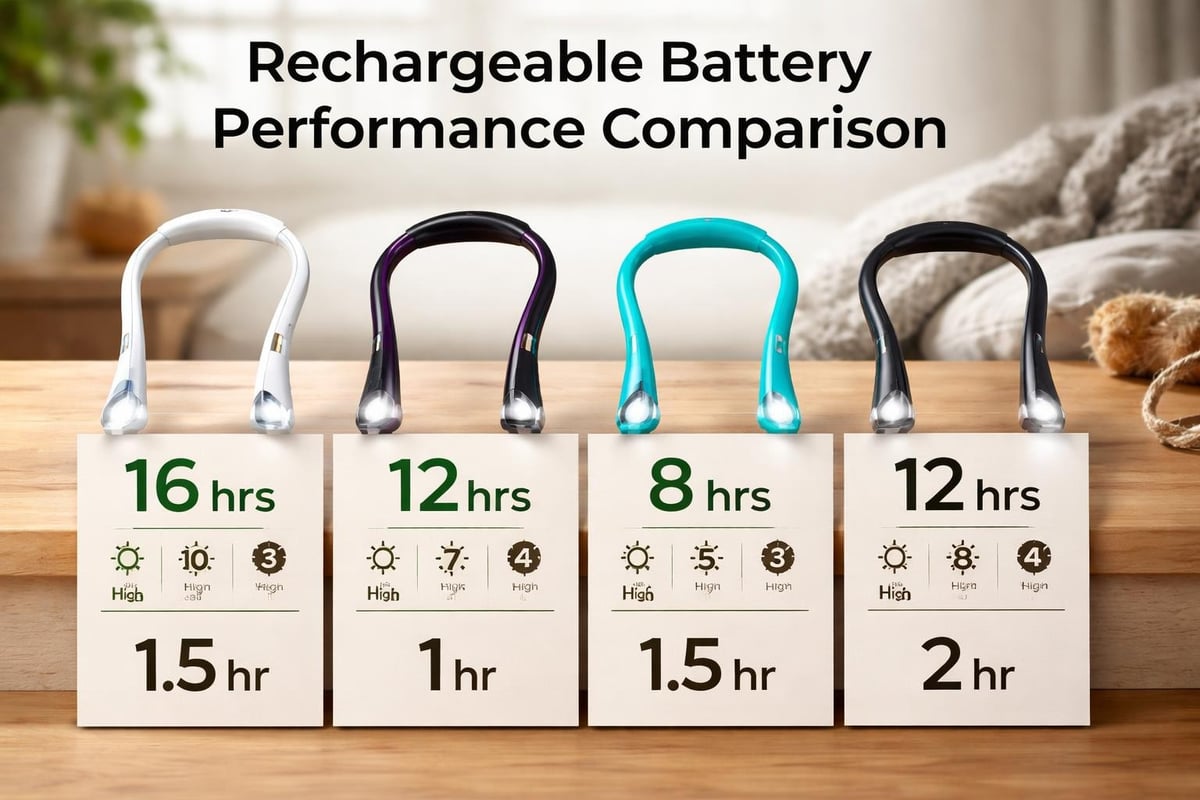
Battery Performance and Charging
Modern rechargeable knitting lights offer impressive battery life, with many models providing 4 to 8 hours of continuous use on a single charge. This runtime proves sufficient for extended knitting sessions, whether you're working through a complex pattern section or enjoying a weekend crafting marathon.
The USB charging capability means you can power up your light using common charging blocks, computer ports, or portable power banks. Charge times typically range from 2 to 3 hours, making it practical to refresh the battery overnight or during breaks.
| Feature | Typical Specification | Benefit for Knitters |
|---|---|---|
| Battery Life | 4-8 hours | Full evening of knitting |
| Charge Time | 2-3 hours | Ready for next session |
| LED Lifespan | 50,000+ hours | Years of reliable use |
| Brightness Levels | 3-5 settings | Customizable to conditions |
Why Knitters Choose Hands-Free Lighting Solutions
The decision to invest in a knitting neck light stems from practical needs that emerge during real-world projects. As knitters advance in their skills and tackle more complex patterns, proper lighting becomes increasingly critical to project success.
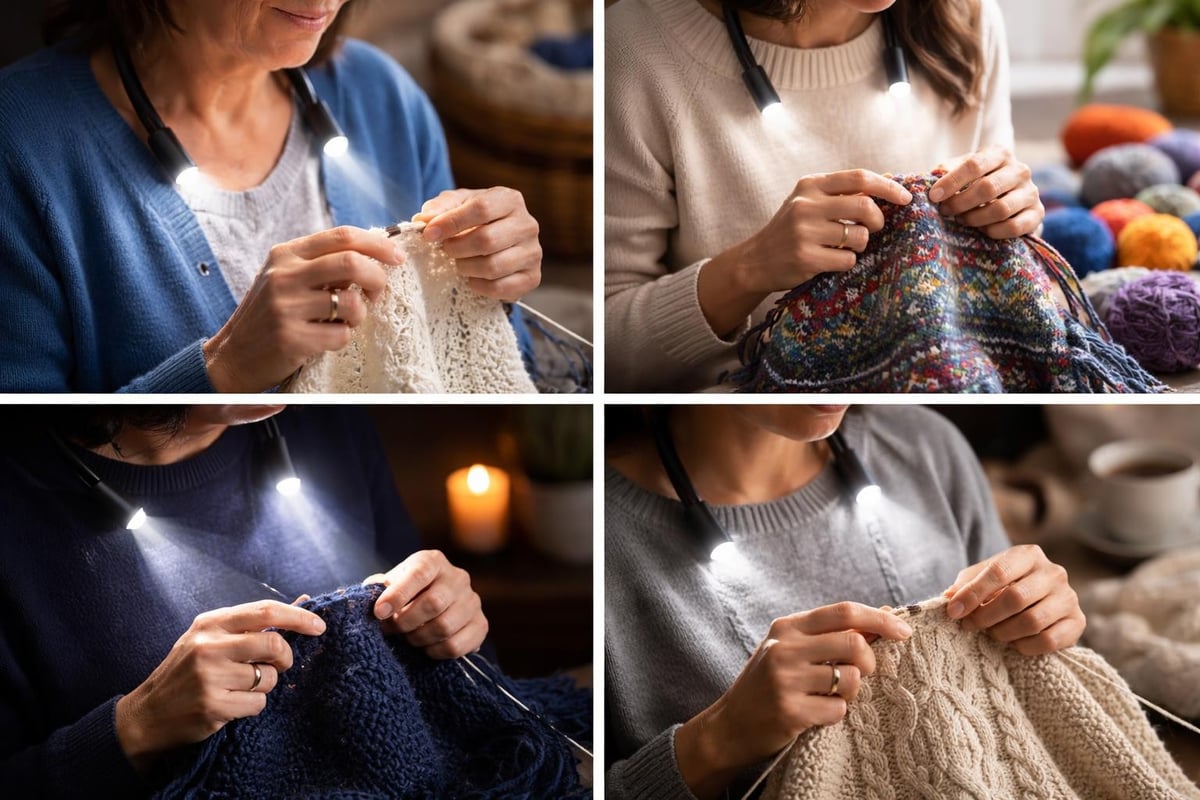
Working with dark yarn colors creates the most obvious lighting challenge. Navy blues, deep purples, blacks, and charcoal grays absorb light rather than reflecting it, making individual stitches nearly impossible to distinguish in poor conditions. Even experienced knitters who can work by touch alone benefit from seeing their stitches clearly when counting, checking tension, or identifying mistakes.
Common scenarios requiring better illumination:
- Evening knitting sessions when natural light fades
- Travel knitting on planes, trains, or in cars
- Working with textured or hairy yarns that obscure stitch definition
- Following complex lace or cable patterns
- Correcting mistakes and picking up dropped stitches
The Mother of Purl Yarn product specifications highlight how adjustable color temperatures address different knitting situations. Warmer light (around 3000K) creates a comfortable ambiance for relaxed evening knitting, while cooler light (5000K+) provides clarity for detailed pattern work.
Eye strain represents another significant concern. Squinting to see stitches or holding your work at awkward angles to catch available light leads to headaches, neck tension, and fatigue. A properly positioned wearable light maintains optimal visibility without forcing your body into uncomfortable positions.
Comparing Lighting Options for Knitters
Before the popularity of wearable lights, knitters relied on various lighting solutions, each with distinct advantages and limitations. Understanding these alternatives helps explain why the lumos knitting light has gained such strong following.
Floor lamps and desk lamps provide powerful illumination but lack portability and create fixed working positions. You must stay within the light's range, limiting where you can comfortably knit. Overhead lighting rarely provides sufficient focused light and often creates shadows from your hands and needles.
Clip-on book lights offer portability but require a surface to attach to and typically lack the power needed for detailed knitting work. Headlamps provide hands-free operation but can feel bulky, create unflattering angles when working with others, and often direct light too far forward rather than down toward your lap.
| Lighting Type | Portability | Hands-Free | Adjustability | Shadow Issues |
|---|---|---|---|---|
| Floor/Desk Lamp | Low | Yes | Limited | Moderate |
| Clip-On Light | Moderate | Yes | Low | High |
| Headlamp | High | Yes | Moderate | Low |
| Neck Light | High | Yes | High | Very Low |
The neck light design positions illumination at an optimal angle, directing light downward and forward to your work area. This placement minimizes shadows from your hands while keeping the light source out of your direct line of sight, reducing glare and eye fatigue.
Practical Applications for Different Knitting Projects
The versatility of a hands-free knitting light extends across various project types and skill levels. From simple scarves to intricate lace shawls, proper illumination enhances every aspect of the knitting process.
Working with Dark Yarn Colors
Dark yarns present the greatest visibility challenge in knitting. When working with deep colored 10-ply wool, even slight variations in ambient light can make it difficult to distinguish individual stitches. The lumos knitting light solves this by providing consistent, directed illumination that reveals stitch structure regardless of yarn color.
Many knitters find that they can work more quickly with dark yarns when using proper lighting. The confidence of seeing each stitch clearly reduces hesitation and second-guessing, allowing your hands to maintain a steady rhythm. This benefit proves particularly valuable when working increases, decreases, or pattern stitches where accuracy matters.
The ability to spot mistakes immediately also saves time. Rather than discovering an error several rows later and having to rip back extensive work, you can catch and correct problems as they happen. This immediate feedback loop improves both efficiency and enjoyment.
Evening and Low-Light Knitting Sessions
Natural light changes throughout the day, and most knitters experience times when ambient lighting becomes insufficient. The transition period around dusk can be particularly challenging, as your eyes struggle to adapt to decreasing light levels.
A rechargeable knitting light allows you to extend your knitting time without depending on fixed lighting installations. Whether you're knitting on the couch while watching television, relaxing in bed before sleep, or enjoying an evening outdoors, portable lighting maintains consistent visibility.
This flexibility particularly benefits knitters who have limited time for their craft. If your main knitting opportunities occur during early mornings or late evenings when household lighting may be minimal, a wearable light becomes essential equipment rather than a luxury accessory.
Travel and Portable Knitting
Many dedicated knitters refuse to waste travel time that could be spent working on projects. Cars, planes, trains, and waiting rooms all present opportunities for productive stitching, but rarely offer ideal lighting conditions.
The compact, portable nature of the lumos knitting light makes it perfect for travel knitting. The device fits easily in a project bag alongside your yarn and needles, requires no installation or setup, and works independently of available power outlets during use.
Travel knitting advantages:
- No need to seek out well-lit seating areas
- Works during night flights or early morning departures
- Eliminates dependence on overhead reading lights
- Allows knitting in various seating positions
- Maintains visibility during vehicle travel (as passenger)
The video demonstration of the Lumos light features showcases how easily the device transitions between different environments, maintaining consistent performance whether you're at home or traveling.
Technical Features That Matter to Knitters
Understanding the specifications of a knitting neck light helps you evaluate whether a particular model meets your needs. While marketing materials emphasize various features, certain technical aspects directly impact the knitting experience.
LED Quality and Color Temperature
LED technology has revolutionized portable lighting, offering bright illumination with minimal power consumption and heat generation. The quality of LEDs varies significantly between manufacturers, affecting both the quality of light and the device's longevity.
Color temperature, measured in Kelvin (K), determines the warmth or coolness of the light. Lower values (2700K-3000K) produce warm, yellowish light similar to traditional incandescent bulbs. Higher values (5000K-6500K) create cool, bluish light that resembles daylight.
For knitting purposes, the ability to adjust between these extremes provides maximum versatility. Cooler light helps with detailed work and accurate color assessment, while warmer light creates comfortable conditions for relaxed evening knitting.
Brightness Adjustment and Control
Multiple brightness levels allow you to optimize light intensity for different situations. Maximum brightness serves well for intricate pattern work or very dark yarns, while lower settings suffice for general knitting with lighter colors.
Some knitters appreciate touch controls that allow brightness adjustment without releasing your knitting. Others prefer simple button controls that resist accidental activation. The ease of adjusting settings while maintaining your grip on needles and yarn affects the overall user experience.
Brightness considerations for different knitting:
- Maximum: Lace patterns, fine yarn, dark colors
- Medium-High: Cable patterns, colorwork, medium tones
- Medium: Stockinette, garter stitch, light to medium yarns
- Low: Simple patterns, light colors, ambient light available
Comfort and Wearability Factors
A knitting light worn around your neck for extended periods must prioritize comfort. The weight distribution, collar material, and flexibility of the arms all contribute to whether the device becomes a helpful tool or an annoying distraction.
Silicone and soft rubber collars provide comfortable contact points that don't dig into skin or catch on clothing. The collar should maintain its position without sliding around during normal head movement, yet remove easily when you take breaks.
Weight becomes noticeable during extended wear. Devices under 150 grams typically feel unobtrusive, while heavier models may cause neck strain during multi-hour knitting sessions. The balance of weight between the collar and light heads affects how the device sits on your shoulders.
Integrating Lighting into Your Knitting Practice
Adding proper lighting to your knitting setup represents an investment in both the quality of your work and your physical comfort. Like quality needles or beautiful yarn from Wild and Woolly Yarns, good lighting tools enhance the entire crafting experience.
Creating an Optimal Knitting Environment
While a wearable light provides portable illumination, combining it with thoughtful environmental lighting creates the best working conditions. Position yourself to avoid glare from windows or screens, and consider how room lighting complements your task light.
The flexibility of a hands-free knitting light means you can adapt to whatever space is available. Whether you prefer knitting in your favorite chair, at a table, or curled up in bed, the light moves with you and adjusts to maintain optimal illumination.
Maintenance and Care
Rechargeable knitting lights require minimal maintenance but benefit from basic care practices. Regular cleaning of the light heads prevents dust buildup that can reduce brightness. A soft, dry cloth typically suffices for routine cleaning.
Battery care extends the lifespan of rechargeable devices. Avoid completely draining the battery before recharging, and store the light with a partial charge if you won't use it for extended periods. Most modern lithium batteries prefer frequent partial charging over deep discharge cycles.
Combining Quality Tools and Materials
Knitters who invest in proper lighting often discover renewed enjoyment in their craft. The ability to see stitches clearly reduces frustration and increases confidence, particularly when working challenging patterns or learning new techniques.
This attention to quality tools complements the use of premium yarns and materials. When you've selected beautiful fiber for a special project, ensuring you can see and work with it properly honors the investment. The knitting tutorials available from experienced knitters often emphasize the importance of proper working conditions, including adequate lighting.
Choosing the Right Light for Your Needs
The market offers various neck light options at different price points and with varying features. Evaluating your specific knitting habits helps identify which features matter most for your situation.
Consider how and when you typically knit. If you work primarily on detailed projects requiring precision, prioritize brightness levels and color temperature options. If portability matters most because you knit in multiple locations or travel frequently, focus on battery life and compact design.
Questions to guide your selection:
- Do you frequently knit with dark yarn colors?
- How long are your typical knitting sessions?
- Do you need lighting primarily for evening use or all-day flexibility?
- Will you use the light mostly at home or while traveling?
- Do you work on detailed patterns or simple repetitive stitches?
The durability and build quality of different models varies significantly. Reading reviews from other knitters provides insight into real-world performance and longevity. The informative content shared by yarn shops often includes recommendations for tools that complement quality yarn work.
Price Considerations and Value
Hands-free knitting lights range from budget options under $20 to premium models exceeding $60. Price typically reflects LED quality, battery capacity, build materials, and brand reputation.
Mid-range options between $25 and $40 generally offer the best balance of features and reliability for serious knitters. These models provide adequate brightness, reasonable battery life, and construction that withstands regular use.
Consider the cost per hour of use when evaluating value. A light that costs slightly more but lasts for years of regular knitting represents better value than a cheaper option requiring frequent replacement.
Proper lighting transforms knitting from a sometimes frustrating activity into a consistently enjoyable craft practice. The lumos knitting light and similar wearable options provide the illumination needed to work confidently with any yarn color, in any location, at any time of day. When you're ready to start your next project with beautiful yarn that deserves to be seen clearly, visit Wild and Woolly Yarns where over 40 years of experience helps knitters find exactly what they need. Our friendly staff understands that great knitting combines quality materials with the right tools, and we're here to support your crafting journey with expert advice and premium supplies.